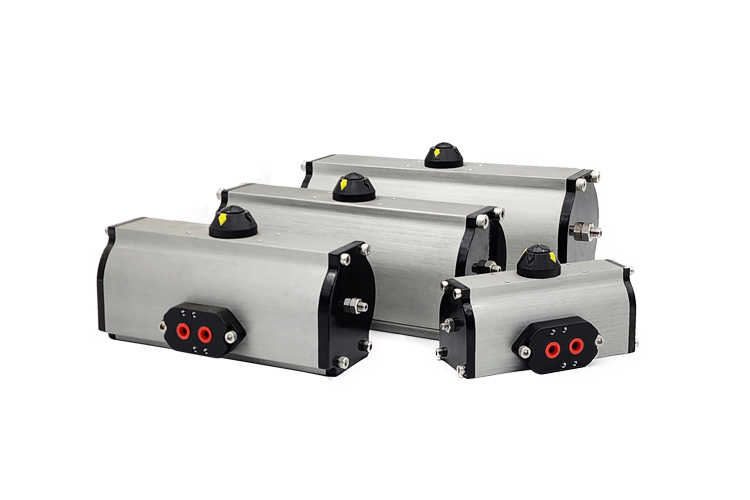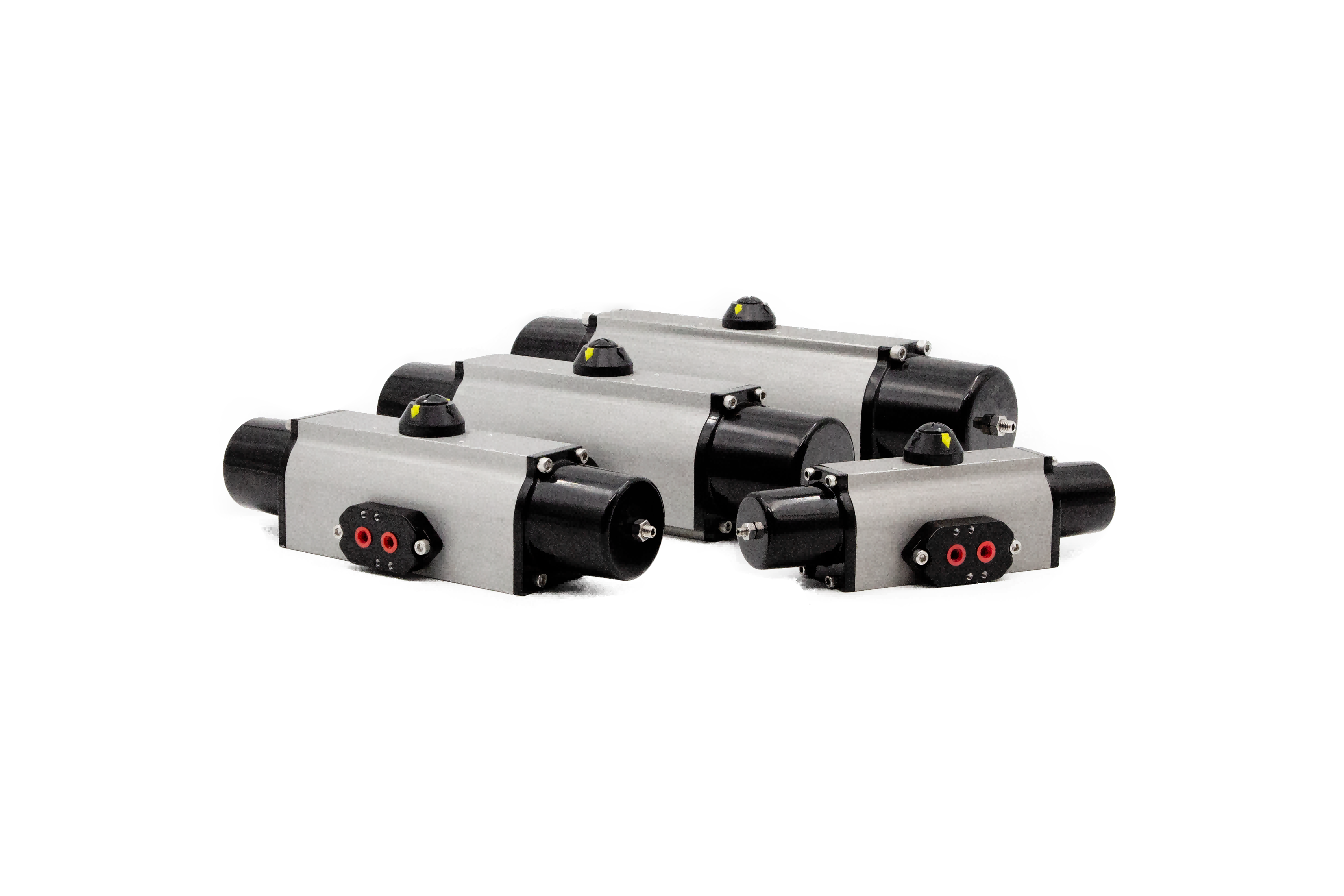








What is a Scotch yoke pneumatic actuator for valves?
 Aug 16, 2024|
 View:1699
Crankshaft: The crankshaft is the rotating component that drives the scotch yoke. Scotch yoke pneumatic actuator is connected to a motor or a pneumatic source that provides the rotary motion.
Scotch Yoke: This is a flat, usually rectangular piece that is pivoted at one end (the crankpin) and connected to the output rod at the other end. As the crankshaft rotates, the scotch yoke moves up and down, converting the rotary motion into linear motion.
Output Rod: The output rod is the linear moving part that is attached to the scotch yoke. It translates the reciprocating motion of the scotch yoke into linear motion for the application.
Pistons and Cylinders: In a scotch yoke pneumatic actuator, pistons and cylinders are used to convert the pneumatic pressure into mechanical force. The piston is attached to the crankshaft, and the cylinder houses the piston.
Seals and Bearings: Seals prevent the leakage of air, ensuring efficient operation. Bearings reduce friction and support the moving parts, ensuring smooth operation.
Air Supply: Compressed air is supplied to the actuator, which powers the piston and moves the crankshaft.
Rotation of Crankshaft: The force exerted by the compressed air causes the piston to move, which in turn rotates the crankshaft.
Linear Motion Conversion: As the crankshaft rotates, the scotch yoke pivots around the crankpin, causing the opposite end of the yoke (connected to the output rod) to move linearly.
Stroke Control: The length of the stroke and the speed of the linear motion can be controlled by adjusting the air supply and the speed of the rotary motion.
Reversal of Motion: By reversing the direction of the air supply, the linear motion can be reversed, allowing the scotch yoke pneumatic actuator to pull as well as push.

High Force Output: Scotch yoke pneumatic can generate high forces with relatively small rotary inputs, making them suitable for heavy-duty applications.
Simple Design: The scotch yoke mechanism is simple and robust, requiring minimal maintenance.
Reliability: Due to their simple and robust design, scotch yoke actuators are highly reliable and have a long service life.
Controllability: The speed and force of the linear motion can be easily controlled by adjusting the air supply.
Energy Efficiency: Pneumatic systems are energy efficient, especially when compared to hydraulic systems.
Versatility: Scotch yoke pneumatic actuators can be used in a wide range of applications, including lifting, pushing, pulling, and pressing.
Double Acting Scotch Yoke Pneumatic Actuator
A double-acting Scotch yoke pneumatic actuator is a type of actuator that uses compressed air to generate rotary motion for operating quarter-turn valves (like ball, butterfly, or plug valves).
Key Characteristics:
• Requires compressed air for both opening and closing movements.
• Generally provides higher torque output than a rack-and-pinion actuator of the same size, especially at the start and end of the stroke.
• The torque profile is sinusoidal—highest at the 90° and 270° positions and lowest at the 0° and 180° positions.
• If air pressure is lost, the valve will stay in its last position (fail-in-place) unless a secondary system (like a spring-return module) is added.
Single Acting Scotch Yoke Pneumatic Actuator
A single acting Scotch yoke pneumatic actuator uses a combination of compressed air and a spring to generate its rotary motion.
Scotch Yoke Single Acting Pneumatic Actuator Key Characteristics:
• Requires compressed air for one direction of movement and uses a spring for the return movement.
• Provides a fail-safe function. Upon loss of air pressure, the scotch yoke single acting pneumatic actuator will automatically return to its default position (e.g., fail-closed or fail-open).
• The available torque is slightly less than an equivalent double-acting model because some of the force from the piston must be used to compress the spring.
• The single acting scotch yoke pneumatic actuator physical size is often larger than a double-acting actuator due to the space required for the spring chamber.
Industrial Automation: Scotch yoke pneumatic actuator are used in assembly lines for moving parts or products.
Material Handling: For lifting and moving heavy materials in manufacturing and warehousing.
Machine Tools: In CNC machines and other automated tools for precise positioning.
Medical Equipment: In devices that require controlled linear motion, such as patient beds or surgical tables.
Agricultural Machinery: Scotch yoke pneumatic actuators are used for controlling the movement of plows, harvesters, and other farming equipment.
Automotive Industry: In assembly lines for the precise placement of components.
Construction Equipment: For controlling the movement of hydraulic rams in excavators and other heavy machinery.
Aerospace: In control systems for aircraft components and satellite deployment mechanisms.
Entertainment: In animatronics and other special effects for movies and theme parks.
Valve Actuation: Scotch yoke pneumatic actuator are used for opening and closing valves in fluid control systems.
When selecting a scotch yoke actuator factory in china, several critical factors must be evaluated to ensure you receive a reliable and high-performance product.
Key selection criteria include the manufacturer's technical expertise in scotch yoke design, which is crucial for achieving high torque output and durability;
The quality of materials and manufacturing processes, ensuring longevity under demanding conditions like high pressure and extreme temperatures;
A proven track record with relevant industry certifications (e.g., ISO, ATEX, SIL);
The availability of customization options to meet specific torque, size, and mounting requirements;
Comprehensive after-sales support, including technical service and global warranty.
You should choose the KANEDE factory because it excels across all these parameters. KANEDE has established a strong reputation for manufacturing robust scotch yoke actuators that deliver consistent performance in critical applications such as oil and gas, power generation, and water treatment.
The factory utilizes advanced production technology and strict quality control measures, resulting in actuators known for their exceptional reliability and long service life.
Furthermore, KANEDE offers significant competitive advantages, including extensive customization capabilities to tailor products to exact specifications, coupled with cost-effectiveness without compromising on quality.
Their commitment to providing excellent technical support and responsive customer service makes them a strategic and trustworthy partner for your actuation needs.