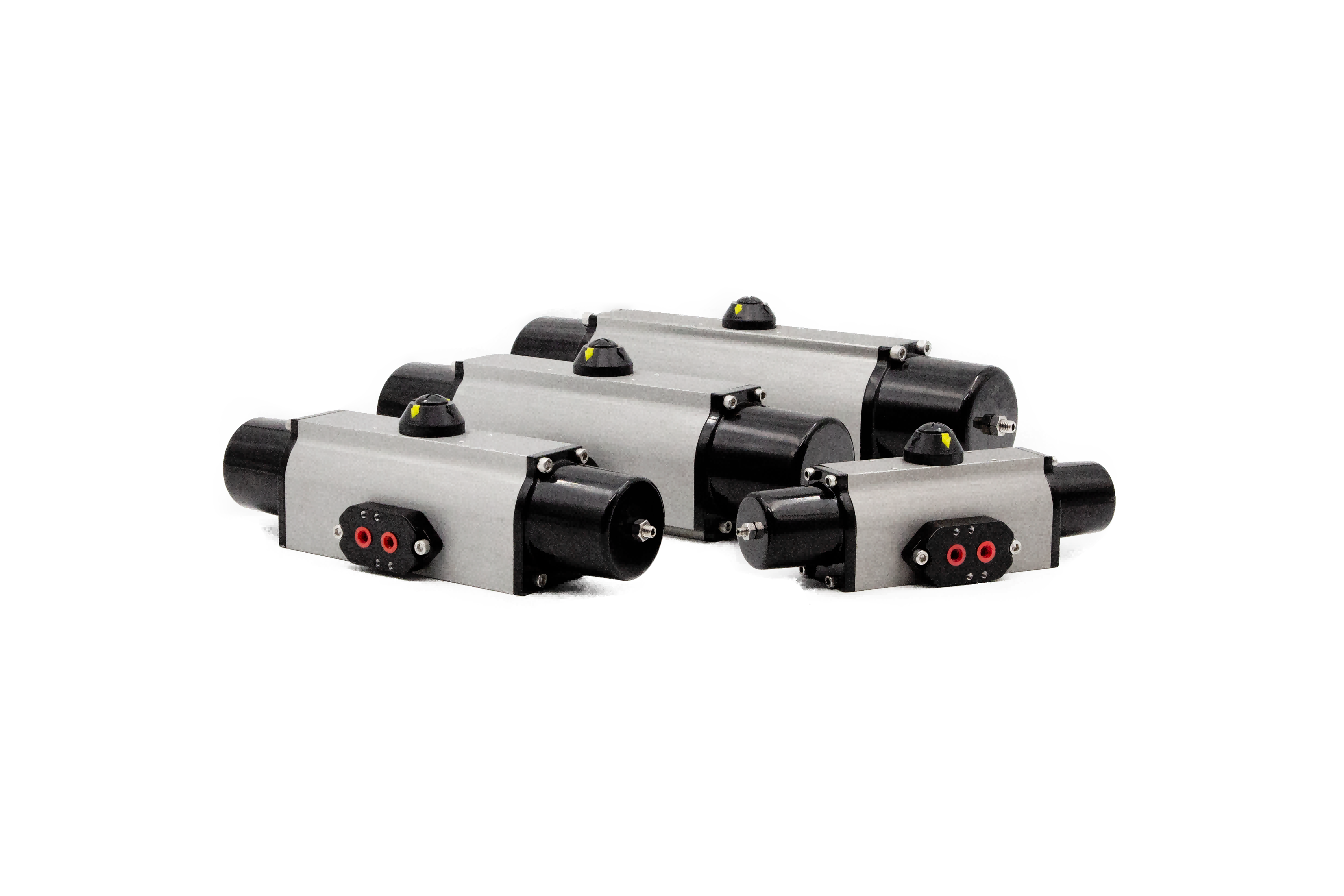








Engineering Excellence: The Single Acting Scotch Yoke Pneumatic Actuator
 Jun 07, 2025|
 View:1521
Pneumatic actuators remain indispensable in industrial automation, and among their diverse designs, the single acting scotch yoke variant stands out for its reliability, safety, and mechanical efficiency. This article explores its engineering principles, applications, and advancements, addressing why it remains a cornerstone in critical process control.
Core Mechanism & Working Principle
The scotch yoke mechanism converts linear piston motion into rotary torque via a sliding yoke and pin arrangement. In single-acting (spring-return) designs:
Actuation: Compressed air drives the piston linearly, rotating the output shaft (typically 90°) to open/close valves.
Spring Return: Air pressure compresses an internal spring; upon air loss, the spring releases energy to return the actuator to its default position (fail-safe open or closed).
Efficiency: The scotch yoke’s near-constant torque profile minimizes radial loads, maximizing energy transfer with minimal friction.
Key Components:
Corrosion-Resistant Cylinder: Hard-anodized aluminum or PTFE-coated internals withstand harsh chemicals and marine environments.
Self-Lubricating Bearings: Reduce wear and extend service life.
Standardized Interfaces: NAMUR-compliant mounting simplifies accessory integration (limit switches, positioners).
Technical Specifications & Performance
Parameter Range Notes
Torque Output 27–39,386 in-lbs Suitable for valves ≤125,000 Nm
Air Pressure 30–145 psi Lower consumption vs. rack-and-pinion
Operating Temp. -40°C to 150°C (-40°F to 302°F) PTFE seals enable cryogenic/high-temp use
Fail-Safe Action Spring-return to open/close Critical for safety shutdowns
Failure Rate (DU) ~1,250 (Dangerous Undetected) Lower risk than motor-driven actuators

Safety & Reliability Advantages
Fail-Safe Priority: Automatic spring return during air/power loss prevents hazardous fluid release (e.g., flammable gases).
ATEX/PED Certified: Explosion-proof designs comply with EU directives for hazardous zones.
IP67M Protection: Sealed against dust and water immersion.
Industrial Applications
Oil & Gas: Emergency shutoff valves (ESD) in pipelines.
Chemical Processing: Corrosion-resistant actuation for ball valves handling acids.
Power Generation: Steam isolation valves requiring high torque and rapid response.
Water Treatment: Spring-return reliability in remote sites with unstable air supply.
Maintenance & Optimization
Best Practices:
Pre-Operational Checks: Verify air pressure (3–7 bar), inspect seals, and test spring response.
Routine Care: Clean internal debris biannually; replace springs every 5 years to maintain fail-safe integrity.
Troubleshooting:
Delayed Return: Check spring fatigue or air leaks.
Torque Drop: Inspect yoke/pin wear or bearing degradation.
Innovations & Future Trends
Smart Integration: IoT-enabled positioners for real-time torque monitoring and predictive maintenance.
Hybrid Designs: Electro-pneumatic variants combining spring-return with electric override.
Material Science: Graphene-coated sliders to reduce friction by 15% and extend cycle life.
The single acting scotch yoke pneumatic actuator epitomizes engineered resilience. Its mechanical simplicity, coupled with unwavering fail-safe operation, makes it irreplaceable in high-risk industries. As automation evolves, its integration with digital systems will further solidify its role in the next generation of intelligent process control.