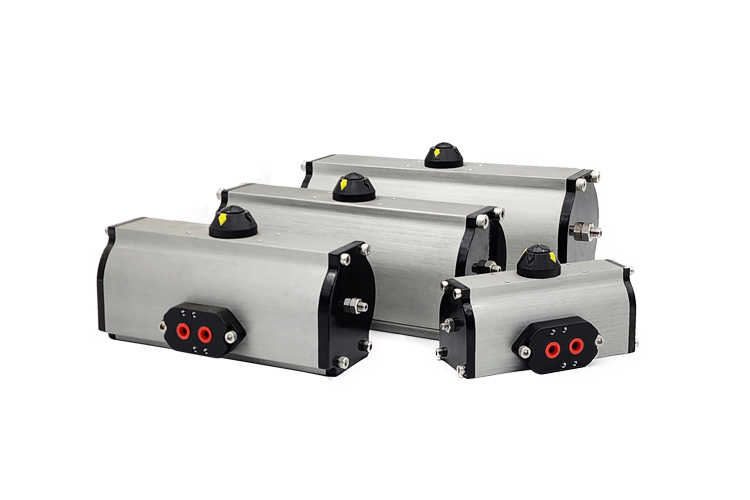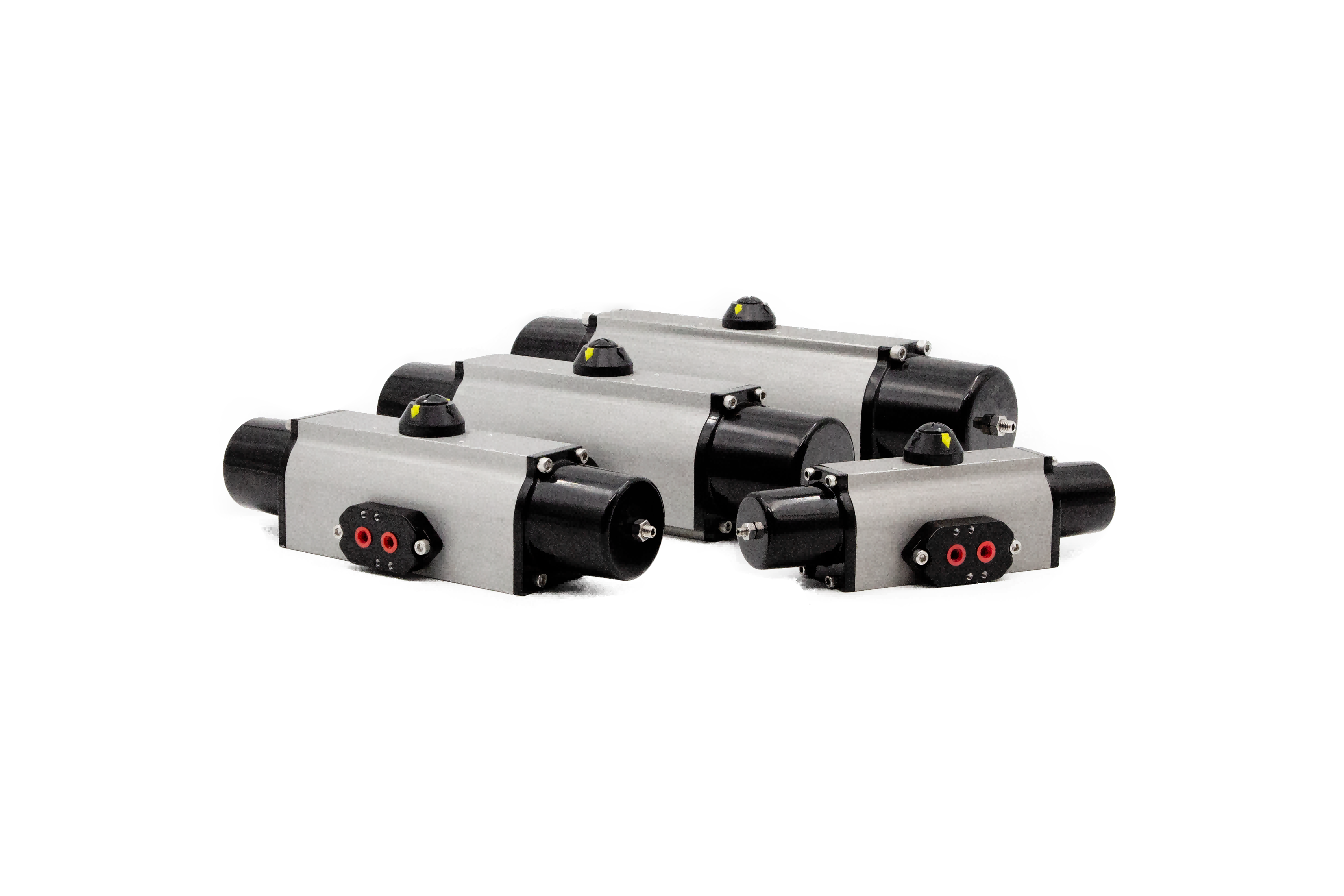







Types of Pneumatic Actuators (Single acting, Double acting, Scotch Yoke)
 Aug 26, 2025|
 View:1174
Pneumatic actuators are indispensable components in modern industrial automation, converting compressed air energy into mechanical motion to control valves, dampers, and a wide array of machinery. Their popularity stems from inherent advantages like cleanliness, high speed, simplicity, and inherent safety in hazardous environments. Among the diverse range of designs, three fundamental types stand out due to their distinct operating principles and application suitability: Single-Acting, Double-Acting, and the mechanically unique Scotch Yoke actuator. Understanding their mechanics, advantages, and limitations is crucial for selecting the right actuator for any given task.
1. Single Acting Pneumatic Actuators
Principle of Operation
As the name implies, a single-acting actuator requires a compressed air supply to perform work in only one direction. The core mechanism involves a single air inlet port. When compressed air is introduced into the actuator's chamber, it pushes against a piston or diaphragm, generating a force that moves the actuator rod in the desired direction (e.g., extending it). This is the "power stroke."
The return stroke—moving the rod back to its original position—is achieved not by pneumatic pressure, but by an internal spring mechanism. Once the air pressure is exhausted or released from the chamber, the stored energy in the pre-compressed spring forces the piston back, expelling the air and resetting the actuator.
Key Characteristics and Applications
Fail-Safe Design: This is the most significant advantage. In the event of a power or air supply failure, the spring automatically returns the actuator to its default "safe" position (either open or closed, depending on the design). This is critical for safety-critical applications like emergency shut-off valves in chemical plants or fire suppression systems.
Simpler Air Supply: They require only a 2-port, 3-way directional control valve (supply and exhaust), simplifying the control circuitry compared to double-acting models.
Lower Air Consumption: Since air is used for only one direction of movement, they consume roughly half the compressed air of an equivalent double-acting actuator for a single cycle.
Limited Force: The major trade-off is that the spring occupies space within the cylinder. For a given cylinder size, the available stroke length and the output force on the power stroke are less than those of a comparable double-acting cylinder. The spring force must be overcome by the air pressure, which also reduces the net output force.
Typical Applications: Single-acting actuators are ideal for tasks where safety and failure position are paramount. Common uses include:
Emergency shut-off (ESD) valves
Spring-return ball or butterfly valves
Clamping fixtures
Packaging machinery where a tool must retract if air is lost
2. Double-Acting Pneumatic Actuators
Principle of Operation
A double-acting actuator uses compressed air to power both strokes—extension and retraction. It features two air inlet/exhaust ports (Port A and Port B). To extend the actuator rod, compressed air is supplied to Port A (the "cap end") while Port B is simultaneously exhausted. The pressure differential pushes the piston, driving the rod outward.
To retract the rod, the process is reversed: compressed air is supplied to Port B (the "rod end") while Port A is exhausted. The pressurized air pushes the piston in the opposite direction, pulling the rod back in. Both movements are therefore powered by pneumatic energy.
Key Characteristics and Applications
Higher Force and Precision: Without an internal spring taking up space, a double-acting actuator can generate a consistent, powerful output force in both directions for a given cylinder size. The absence of a spring also means there is no opposing force to overcome, allowing for more precise control over the position and force.
No Default Fail Position: This is the primary disadvantage. If the air supply fails, the actuator will simply stop and remain in its last position (fail-in-place). This may not be acceptable for many safety-interlocked processes. To achieve a fail-safe operation, external systems like an air reservoir (accumulator) or a mechanical spring-return module must be added.
Greater Air Consumption: They require approximately double the compressed air per cycle compared to a single-acting actuator, as air is used to drive both motions.
More Complex Control: They require a 4-port, 5-way or 5-port, 4-way directional control valve to manage the air supply to both ports.
Typical Applications: Double-acting actuators are the workhorses of industry wherever high force, precise control, or a lack of a default fail-safe requirement exists.
Process control valves requiring modulation
Robotics and automation for precise linear movement
Material handling equipment
Large gate valves and other high-torque applications
3. Scotch Yoke Pneumatic Actuators
Principle of Operation
The Scotch Yoke is a distinct type of rotary actuator, meaning it converts linear pneumatic force into a rotary motion (typically 90° or 180°), unlike the linear output of the previous two types. It is almost exclusively built in a double-acting configuration.
The mechanism consists of a piston connected to a sliding yoke or slotted bar. As the piston moves linearly under air pressure, the yoke engages a pin that is fixed to the output shaft. This linear motion of the yoke forces the pin (and thus the shaft) to rotate. The "scotch yoke" mechanism is a classic way to transform linear motion into rotary motion.
Key Characteristics and Applications
High Torque Output: The mechanical advantage of the scotch yoke design provides extremely high starting and running torque in a compact package. The torque profile is unique: it is highest at the beginning and end of the stroke (around 0° and 90°) and lowest in the middle (around 45°). This is often ideal for valves that are hardest to open or close when seated.
Excellent Rigidity and Durability: The robust construction and simple mechanical linkage make it highly resistant to shock loads and suitable for heavy-duty, high-cycle applications.
Precise 90° Rotation: It provides a true, consistent quarter-turn output, perfect for operating ball, plug, and butterfly valves.
Size and Weight: They are typically larger and heavier than other rotary actuators like rack-and-pinion designs for the same torque output.
Torque Characteristic: The variable torque profile, while beneficial for breakaway, may not be suitable for all applications where a consistent torque is required throughout the stroke.
Typical Applications: Scotch yoke actuators are the powerhouse choice for demanding valve operations.
Large, high-pressure ball valves and butterfly valves in oil and gas pipelines
High-pressure steam applications in power generation
Dirty or harsh environments where robustness is key
Any application requiring very high torque for a quarter-turn valve
Comparative Summary and Selection Criteria
Feature | Single-Acting | Double-Acting | Scotch Yoke (Rotary) |
|---|---|---|---|
Operation | Air in one direction, spring return | Air in both directions | Air in both directions (Rotary Output) |
Fail-Safe | Yes (Spring return to safe position) | No (requires add-ons) | No (requires add-ons) |
Air Consumption | Lower | Higher | Higher (for equivalent torque) |
Force/Torque | Lower (spring takes up space) | Higher and consistent | Very High (with unique profile) |
Control Complexity | Simple (3-way valve) | More complex (5-way valve) | More complex (5-way valve) |
Primary Use | Safety shut-off, short stroke | Precision linear motion, process control | High-torque quarter-turn valves |
The Global Manufacturing Landscape: Pneumatic Actuator Factory in China (KANEDE)
The rise of China as the "workshop of the world" is particularly evident in the industrial valve and actuator sector. Chinese manufacturers have evolved from producing basic components to becoming leaders in quality, innovation, and global supply. Among these, the KANEDE factory has established itself as a prominent name.
KANEDE exemplifies the modern Chinese manufacturing ethos, combining advanced production capabilities with a strong focus on international quality standards. Here’s what sets a factory like KANEDE apart:
Advanced Manufacturing and Quality Control: KANEDE invests in state-of-the-art CNC machining centers, automated assembly lines, and rigorous testing facilities. Each actuator undergoes stringent testing for air tightness, torque output, and operational cycles to ensure reliability that meets or exceeds international standards like ISO 5211, ISO 9001, and ATEX for hazardous environments.
Technical Expertise and Customization: Beyond standard catalog products, factories like KANEDE possess the engineering expertise to provide custom solutions. This includes designing actuators for specific torque requirements, unusual valve interfaces, special coatings for corrosive environments (C4, C5), and extreme temperature ranges.
Cost-Effectiveness without Compromise: By leveraging economies of scale and efficient manufacturing processes, Chinese factories like KANEDE offer a significant competitive advantage. They provide high-quality Scotch Yoke actuators that deliver exceptional performance and durability at a more accessible price point, making automation feasible for a wider range of projects globally.
Global Supply Chain Capability: With a deep understanding of international logistics and certification requirements, KANEDE can reliably supply products to customers in North America, Europe, the Middle East, and Southeast Asia, ensuring timely delivery and technical support.
In conclusion, the single-acting actuator offers a simple, fail-safe solution; the double-acting actuator provides powerful, precise control in both directions; and the robust scotch yoke delivers immense torque for the most challenging rotary valve applications. Their continued evolution ensures they remain fundamental drivers in the automated industrial world.