






What is a Double Acting Scotch Yoke Pneumatic Actuator?
 Aug 28, 2025|
 View:1062
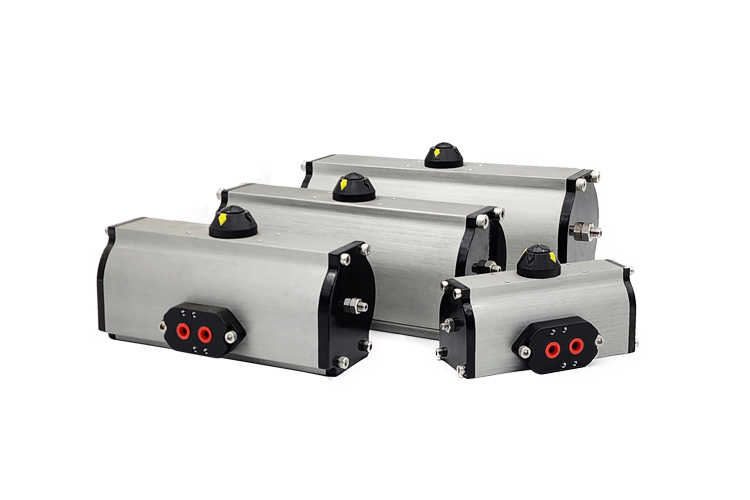
A double acting scotch yoke pneumatic actuator is a device that converts energy into motion. A pneumatic actuator specifically uses compressed air as its energy source. The primary challenge is transforming the linear force generated by pressurized air into a usable rotary output, which is essential for operating valves (quarter-turn valves like ball, butterfly, and plug valves), dampers, and other industrial equipment.
The Scotch yoke mechanism is a classic mechanical assembly designed to achieve precisely this conversion. Its name derives from its resemblance to a yoke used to harness oxen and its historical association with Scotland. The mechanism's elegance lies in its simplicity and mechanical advantage.
In a double acting Scotch yoke pneumatic actuator:
Compressed air enters one side of the actuator's cylindrical chamber, driving a piston in a linear direction.
The piston is connected to a sliding yoke (or slotted link) via a piston rod and a pin. This pin is engaged within the slot of the yoke.
As the piston moves linearly, the pin pushes against the walls of the slot in the yoke, forcing the yoke to move. However, because the yoke is constrained, this linear motion is converted into a rotary motion.
The yoke is connected directly to the actuator's output shaft. As the yoke moves back and forth, it causes the output shaft to rotate through a precise 90-degree arc (from 0° to 90°).
The "double-acting" designation is crucial. It means the actuator uses air pressure to drive the piston in both extending and retracting strokes. Compressed air is alternately supplied to either side of the piston to generate movement in both directions. This contrasts with a "spring-return" or single-acting design, which uses air for one stroke and a mechanical spring to return the piston to its original position.
Deconstructing the Design: Key Components
A typical double acting Scotch yoke pneumatic actuator comprises several key components:
Cylinder Body: The pressure vessel that contains the compressed air and guides the piston.
Piston: The component that moves linearly under the pressure of the air. It is equipped with seals to prevent air leakage across its sides.
Piston Rod & Pin: The rod connects the piston to a pin, which is the interface with the yoke's slot.
Yoke (Slotted Link): The heart of the mechanism. It is a rigid component with a precise machined slot. The pin's travel within this slot dictates the rotational output.
Output Drive Shaft: The shaft that rotates and provides the torque to the connected device (e.g., a valve stem). It is typically sealed with bearings and O-rings.
End Caps: Seal the ends of the cylinder body and often contain ports for the air supply.
Air Inlets: Two ports (one on each end cap) for the supply of compressed air to either side of the piston.
The Unique Torque Profile: A Defining Characteristic
One of the most significant and often-cited features of the Scotch yoke design is its non-linear torque output. Unlike rack-and-pinion actuators, which provide a relatively constant torque, the torque output of a Scotch yoke varies throughout its 90-degree stroke.
Maximum Torque at Start and End: The torque is highest at the 0° and 90° positions. This is because the mechanical advantage is greatest when the pin is at the top or bottom of the yoke's slot, creating the largest moment arm.
Minimum Torque at Mid-Stroke: The torque is at its minimum around the 45° position, where the moment arm is shortest.
This inherent torque profile is a double-edged sword and must be carefully considered during the selection process.
Advantages of the Double Acting Scotch Yoke Pneumatic Actuator
High Torque Output: The mechanical design of the Scotch yoke allows it to generate very high torque from a relatively compact cylinder size, especially at the start and end of the stroke. This makes it ideal for applications requiring high breakaway torque to unseat a stuck valve.
Compact and Robust Design: The mechanism is inherently strong and simple, with fewer small parts than a equivalent rack-and-pinion design. This often results in a more robust construction capable of withstanding harsh environments and heavy loads.
Excellent Rigidity and Stability: The yoke provides a stable, guided motion for the piston assembly, minimizing side loads and wear on the piston seals. This leads to a longer service life and consistent performance.
Precise 90-Degree Rotation: The mechanism is mechanically limited to a exact quarter-turn, eliminating the need for external stops in most cases. This ensures reliable and repeatable positioning.
Double-Acting Efficiency: Utilizing air pressure for both strokes provides consistent speed and force in both directions. There is no energy wasted in compressing a spring, as in a spring-return model, making the double-acting design slightly more energy-efficient for continuous operation.
Disadvantages and Considerations
Non-Uniform Torque Profile: As discussed, the varying torque can be a disadvantage if the application requires consistent torque throughout the entire stroke. If the valve's required operating torque is highest in the mid-stroke, a Scotch yoke may not be the ideal choice.
Higher Friction: The sliding contact between the pin and the slot in the yoke can generate more friction than the meshing gears of a rack-and-pinion design. This can lead to slightly lower mechanical efficiency and potentially higher wear over time, necessitating lubrication in some models.
Limited Stroke Customization: The 90-degree stroke is fixed by the geometry of the yoke. It is not easily modified for different rotation angles, unlike some linkage-style actuators which can be adjusted.
Potential for Impact at End of Stroke: The piston can reach high velocities at the end of its travel, potentially causing a hammering effect. This can be mitigated with cushioning or flow control valves in the air ports.
Applications: Where the Scotch Yoke Excels
The double acting Scotch yoke pneumatic actuator is the preferred choice in numerous demanding applications:
High-Pressure and Large-Size Valves: Its ability to generate high breakaway torque makes it perfect for operating large ball valves and butterfly valves in oil and gas pipelines, water treatment plants, and power generation facilities, where valves can be large and under significant pressure.
Dampers in Power Plants and HVAC: Large industrial dampers controlling the flow of air or gas require substantial torque to move, which the Scotch yoke readily provides.
Harsh Environments: Its robust construction with fewer small parts makes it suitable for environments with extreme temperatures, vibrations, and potential exposure to corrosive elements.
Applications where Fail-Safe is not Critical: Since the double-acting model requires air pressure to hold its position, it is used in situations where a loss of air pressure does not necessitate an automatic safe-state closure (which would require a spring-return mechanism).
The double acting Scotch yoke pneumatic actuator is a testament to the power of intelligent mechanical design. While its unique torque profile may not make it a universal solution for every application, its strengths are undeniable. It offers an unparalleled combination of high torque, compact robustness, and mechanical simplicity, making it an indispensable component in heavy-duty industrial automation. By understanding its operating principles, characteristics, and ideal use cases, engineers and technicians can effectively leverage this powerful tool to ensure reliable and efficient operation in the most demanding environments.